Manual Treadmill Explained: Benefits, Top Models & Comparison
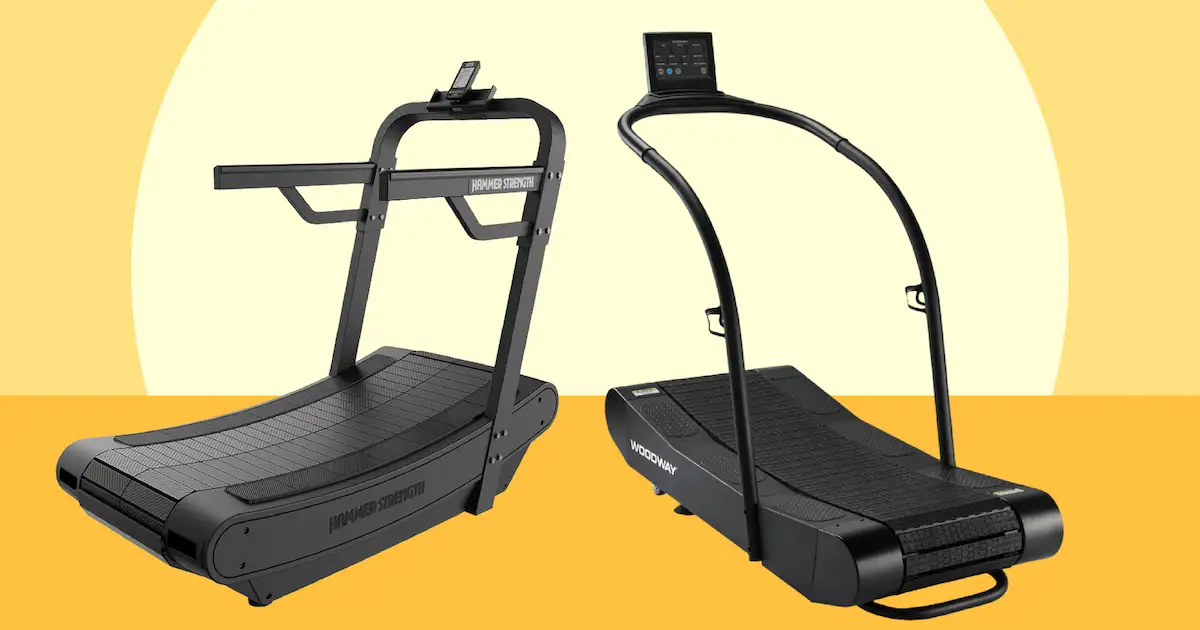
Self-powered treadmills are gaining popularity in the American treadmill market, particularly in the high-end and professional segments. Their success is driven by a growing interest in more natural training methods, trends like CrossFit, and the expansion of home fitness. While they remain a niche segment compared to traditional motorized treadmills, they are experiencing strong growth. Here is a complete guide to self-powered treadmills, also commonly known as curved treadmills or hamster treadmills.
What Is a Manual Treadmill?
A manual treadmill (also called self-powered or curved treadmill) is a treadmill that moves only when you move it, exactly like a hamster wheel. There's no motor, no speed buttons, and no electricity required. Each of your steps drives the belt forward—it responds instantly to your effort. Run faster and it speeds up, slow down and it follows. This creates a fundamentally different experience than motorized treadmills where you're essentially trying to keep up with a pre-set speed.
The modern self-powered treadmill typically features a curved design with a slat belt. This distinctive shape often requires an adaptation period for new users. This isn't the same as the cheap flat manual treadmills you might remember from decades past. Those flat-belt manual treadmills required significant effort just to get moving and felt clunky at best. Curved treadmills solved that problem with their concave shape, which uses gravity and body position to make the belt responsive to natural running mechanics. The result is something that actually feels usable for running, not just walking.
Woodway: The Brand That Started It All
It's impossible to discuss curved treadmills without mentioning the reference brand: Woodway. This German-American company invented the concept and released the first commercial models in 1974. When most people picture a typical "hamster wheel treadmill," they're usually imagining a Woodway Curve. The company now offers several self-powered treadmill models, including the iconic Woodway Curve.
Many companies like Hammer Strength, Technogym, and AssaultFitness have developed their own self-powered treadmill models, but Woodway remains the reference in the collective consciousness. The company boasts that their slat belts can last up to 150,000 miles—enough to circle the Earth six times. Professional sports teams, military training facilities, and rehabilitation centers worldwide use Woodway equipment precisely because it handles brutal daily use for years without breaking down.
How the Curved Design Works
When you stand on a curved treadmill, your position on the belt determines how fast it moves. Step toward the front (the higher part of the curve) and you accelerate. Move toward the middle or back and you decelerate. This happens naturally with your running stride—your forward lean and foot strike position control speed without touching any buttons.
The physics are straightforward. Gravity pulls the belt down the curve as you push against it with each stride. A slight forward lean creates momentum. The steeper the curve, the easier it is to get the belt moving but the harder it is to control at high speeds. Different manufacturers use different curve angles—TrueForm uses a shallow curve for better control, while some budget models have steeper curves that feel easier to start but twitchier at pace. Most runners need a few sessions to adapt their stride, but after that the adaptation comes naturally.
Slat Belts vs. Traditional Belts
High-end manual treadmills use slat belts instead of the continuous rubber belts found on motorized machines. A slat belt consists of individual rubberized slats—typically made of vulcanized rubber—connected in a chain that rolls over the curved frame on precision ball bearings. Woodway, the company that pioneered this design, uses 112 ball bearings and 12 roller guides on their Curve model.
Slat belts absorb more impact than traditional belts, reducing stress on joints and connective tissue. They also last dramatically longer than conventional belts—some models can handle more than 100,000 miles before needing replacement. Compare that to a motorized treadmill belt that typically needs replacement every 3,000 to 5,000 miles. There's also no need for lubrication or belt adjustment. The trade-off is cost: slat-belt treadmills start around $2,000 and easily climb past $6,000 for commercial-grade models.
Benefits of Manual Treadmills
A major benefit of manual treadmills is that they burn more calories at the same speed—but be careful, maintaining the same speed is also more difficult. A study published in the Journal of Science and Medicine in Sport found that runners working at the same perceived effort burned 30% more oxygen and had 16% higher heart rates on non-motorized treadmills compared to motorized ones. The perceived exertion was 27% higher. In practical terms, a 30-minute session on a manual treadmill delivers roughly the same workout as 40 minutes on a motorized one.
Running form improvements are perhaps more valuable long-term. The curved surface naturally encourages a midfoot or forefoot strike rather than heel striking. You have to lean slightly forward and drive through your stride—there's no option to shuffle along letting the belt do the work. This engages the posterior chain (glutes, hamstrings, calves) more intensively than motorized treadmill running. Many coaches use curved treadmills specifically to correct running mechanics in athletes.
The practical benefits matter too. No motor means no electricity bill, no waiting for the belt to reach your target speed, and no maximum speed limit. You can sprint as fast as your legs will carry you and transition to a jog instantly. For interval training or HIIT, this responsiveness is far easier than constantly changing the speed on a console. The reduced maintenance is real—fewer moving parts means fewer things that can break. Most users only need occasional cleaning and bearing checks.
Drawbacks and Limitations
Manual treadmills require more effort by design. That's a feature for HIIT workouts and a bug for long steady-state runs. Research from the University of Essex found that runners had 38% worse running economy on curved treadmills—meaning they burned more energy to cover the same distance at the same speed. If your goal is logging easy miles while watching Netflix, a non-motorized treadmill will make that difficult. The constant effort to maintain pace is mentally demanding—you have to stay focused constantly during the run.
The learning curve is real. First-time users often struggle with speed control and feel unstable on these hamster wheel treadmills. The narrow belt width—typically 17 inches versus 20+ inches on motorized treadmills—adds to the initial awkwardness. Most people adapt within a few sessions, but some never get comfortable. The running mechanics also differ enough from outdoor running that some long-distance runners find manual treadmill training doesn't translate well to race performance.
Then there's the weight and size issue. Commercial-grade curved treadmills weigh 250 to 400 pounds. Moving one requires at least two people and a solid plan. The footprint is comparable to motorized treadmills, but the weight makes placement essentially permanent. Oh, and there's no incline adjustment—the curve is what you get.
Who Should Buy a Manual Treadmill
Athletes focused on speed work and HIIT training get the most value from a manual treadmill. The instant speed response makes sprint intervals more effective than on any motorized treadmill. CrossFit athletes, functional fitness competitors, and team sport athletes (soccer, basketball, football) benefit from the explosive training possibilities. If your workout includes 10-20 second all-out sprints followed by recovery periods, a non-motorized treadmill is purpose-built for that.
Runners looking to improve form should also consider one. Heel strikers forced onto a curved treadmill will naturally shift toward midfoot striking within minutes—the curved surface essentially demands it. Physical therapists and running coaches often use these hamster wheel treadmills as form correction tools. The enhanced muscle engagement also benefits those doing strength-focused cardio work.
Home gym owners who hate maintenance and electricity costs appreciate the simplicity of manual treadmills. Once installed, a quality curved treadmill will run trouble-free for years. There's something satisfying about workout equipment that requires nothing but your effort to operate.
Who Should Avoid Manual Treadmills
Long-distance runners training for marathons or half-marathons will find non-motorized treadmills frustrating as their primary training tool. Maintaining a steady easy pace for 60+ minutes is exhausting when you're powering the belt yourself. The biomechanics also differ enough from road running that the specificity benefit diminishes. These runners are better served by quality motorized treadmills for their long runs.
Beginners and those returning to fitness after a long break should probably start elsewhere. The learning curve, combined with the higher intensity of manual treadmills, creates a rough entry point. Building a cardio base on a motorized treadmill or elliptical before transitioning to curved training makes more sense. The same applies to anyone with balance issues or coordination challenges—the moving belt beneath a curved surface requires more stability than standard treadmill walking.
Those who want guided workouts, streaming classes, or entertainment integration won't find it here. Most curved treadmills have basic LCD displays showing time, distance, speed, and calories. No touchscreens, no iFIT, no Peloton instructors. You're on your own with a self-powered treadmill.
Top Manual Treadmill Models Compared
| Model | Brand | Price | Running Surface |
|---|---|---|---|
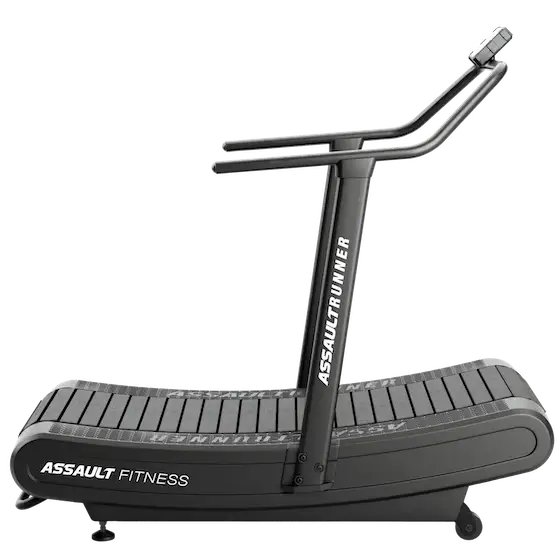 Assault Fitness AssaultRunner Classic Assault Fitness AssaultRunner Classic
|
Assault Fitness | $2,799.00 | 62.00" x 17.00" |
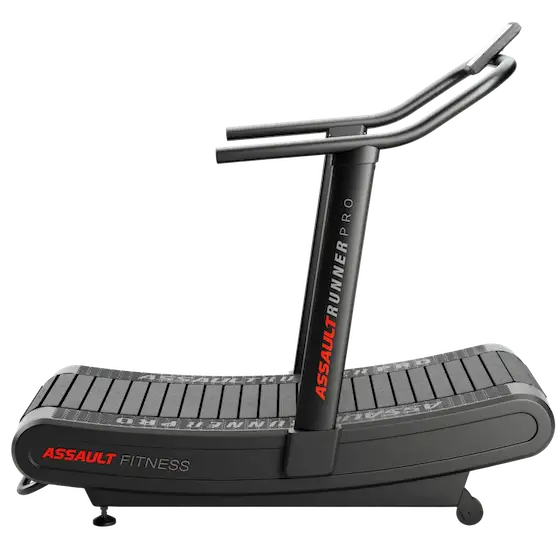 Assault Fitness AssaultRunner Pro Assault Fitness AssaultRunner Pro
|
Assault Fitness | $3,499.00 | 62.00" x 17.00" |
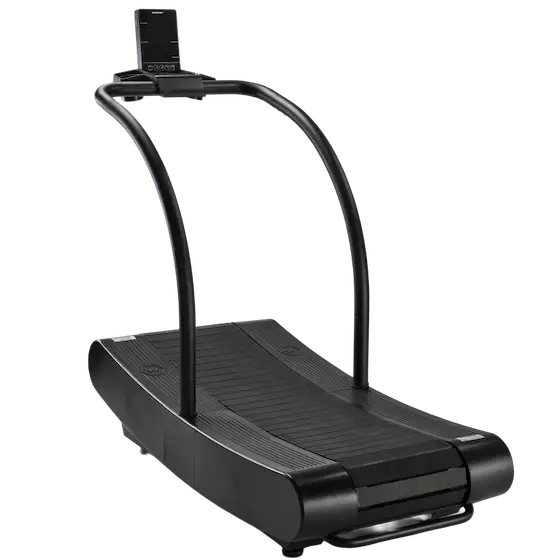 Woodway Curve LTG Woodway Curve LTG
|
Woodway | $3,999.00 | 62.00" x 17.00" |
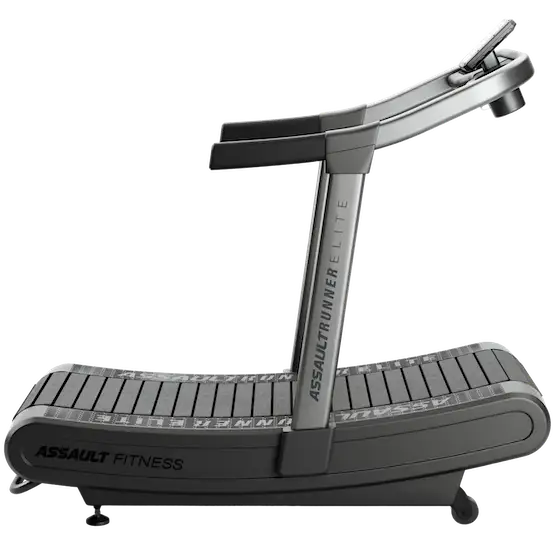 Assault Fitness AssaultRunner Elite Assault Fitness AssaultRunner Elite
|
Assault Fitness | $4,499.00 | 65.00" x 17.00" |
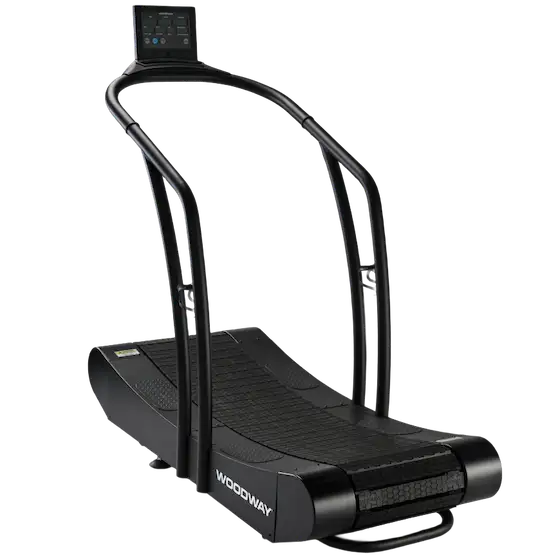 Woodway Curve Woodway Curve
|
Woodway | $3,999.00 | 67.00" x 17.00" |
Woodway remains the gold standard for non-motorized treadmills. Their original Curve model costs over $5,000 but delivers commercial-grade durability with an 800-pound walking capacity and a belt designed to last 150,000 miles. The partnership with Rogue produced the Curve LTG—essentially the same quality at a more accessible price point around $4,000. AssaultRunner offers the best value for most home gym owners looking at manual treadmills. The Pro model at roughly $3,000 handles sprint intervals and HIIT work excellently, though some users report plastic components cracking over time. TrueForm's shallow curve design specifically targets running form improvement and feels different from steeper-curved competitors.
Manual vs. Motorized Treadmill: Quick Comparison
| Feature | Manual (Curved) | Motorized |
|---|---|---|
| Power source | User-powered, no electricity | Electric motor |
| Speed control | Instant, via body position | Button-controlled, slight delay |
| Maximum speed | Unlimited (as fast as you can run) | Typically 10-12 mph |
| Calorie burn | ~30% higher at same effort | Standard |
| Running form impact | Encourages midfoot strike | Neutral (allows heel striking) |
| Incline options | Fixed curve only | Adjustable (0-15%+) |
| Belt lifespan | Up to 150,000 miles (slat belt) | 3,000-5,000 miles typical |
| Maintenance | Minimal | Regular lubrication, belt adjustment |
| Price range | $2,000-$6,000+ | $300-$4,000 |
| Best for | HIIT, sprints, form work | Steady runs, walking, beginners |
Final Verdict
Non-motorized curved treadmills deliver on their promises. You will burn more calories. Your running form will likely improve. The machine will outlast most motorized treadmills with far less maintenance. But the intensity isn't optional—every step requires effort, and that makes these manual treadmills poorly suited for casual jogging or walking-focused fitness routines.
For the right user—someone focused on HIIT, sprint work, or athletic conditioning—a self-powered treadmill is arguably the best cardio investment available. The $2,000 to $4,000 price range gets you equipment that'll last a decade or more with essentially zero upkeep. For everyone else, a quality motorized treadmill with incline capability probably makes more sense. Know your goals before you buy a hamster wheel treadmill.